
• Home
  • About Me
  • How I Work
  • What To Expect
  • Fees And Payment
  • Contact
    • Location and Opening Hours
  • Supervision

Create Your Personal Stress Management Toolkit

6/5/2018

0 Comments

 
A balloon labelled stress about to be popped with a needle
Stress balloon about to be popped. Copyright: ByEmo

This year’s Mental Health Awareness Week, which runs from 14th to 20th May, is focusing on stress. To help you prevent and reduce stress, and to improve your ability to cope with it, here are some tips for creating your personal stress management toolkit.
 
Stress is something we all experience at some point in our lives. It’s a key factor in many mental health problems, yet too often we fail to recognise (or choose to ignore) we’re experiencing it until we reach crisis point.
 
Stress can be caused by:

  • being placed under pressure
  • facing big changes
  • worrying about something
  • not having control over the outcome of a situation
  • having responsibilities that are overwhelming
  • not having enough work, activities or change in your life
  • times of uncertainty[i]
 
Stress can affect how we feel and behave. It can also create a wide range of physical symptoms, including: panic attacks, muscle tension, difficulty sleeping, headaches, nausea, indigestion, and chest pain.
 
You can improve your ability to cope with stress by:
 
1) Managing external pressures – to do this, identify your stress triggers, look for ways to address the cause(s), realistically plan your available time, ask for help and support, and accept the things you can’t change[ii]
 
2) Developing emotional resilience – to do this, look at making lifestyle changes (e.g. taking up a hobby), look after your physical health, be kinder to yourself, take a break, and build up your support network[iii]
 
To help you with these, it can be useful to create a personal toolkit of resources and materials.
 
Your stress management toolkit can be made up of:

  • To-do list or task planners
  • Time management schedulers
  • Communication tips and reminders to be assertive
  • A journal (to help track and identify stress triggers)
  • Meal planners
  • Self-care items (e.g. relaxation colouring books, bubble bath, favourite books, records, recipes etc.)
  • Favourite sayings, mottos or quotes
  • Memory prompts (e.g. objects or photos of family, friends and favourite places as a reminder of relaxed times in your life)
  • A list of hobbies you enjoy doing
  • A list of places you enjoy visiting
  • Mindfulness meditations
  • Sleep hygiene tips (read more about how to sleep better)
  • Phone numbers of friends
  • A list of support organisations and helplines (e.g. for housing, finance, debt, insurance, work union, student support, addiction, abuse etc.)
  • Contact details for your GP
  • Contact details for a therapist (here are my contact details)
  • Anything else you find helpful!
 
As well as helping to improve your ability to cope with stress, regularly using your stress management toolkit can help you to identify triggers and prevent stress before it occurs. The result: improved mental health and wellbeing.


[i] Mind, How To Manage Stress: What causes stress?, Available: https://www.mind.org.uk/information-support/types-of-mental-health-problems/stress/causes-of-stress/#.Wu7iJ8gh2gQ
 
[ii] Mind, How To Manage Stress: How can I deal with pressure?, Available: https://www.mind.org.uk/information-support/types-of-mental-health-problems/stress/dealing-with-pressure/#.Wu7mxMgh2gQ

[iii] Mind, How To Manage Stress: How can I be more resilient?, Available: https://www.mind.org.uk/information-support/types-of-mental-health-problems/stress/developing-resilience/#.Wu7mxsgh2gQ
0 Comments

How To Sleep Better and Improve Your Mental Health

26/3/2018

0 Comments

 
A woman sleeping peacefully in her bed at night
Woman asleep in bed. Copyright: Tartila

With the clocks changing, now is a good time to think about your sleep. Your sleeping pattern can affect your mental health, increasing feelings of anxiety, depression and stress. If your sleep is poor and you’re struggling to get some much needed zzzzs, take a look at how to sleep better and improve your mental health.
 
The Facts
 
Did you know we spend around a third of our lives asleep? Sleep is as important to our health as eating, drinking and breathing.[i] And a lack of sleep can affect both our physical and mental health.
 
Medicine has identified more than 80 different sleep disorders and problems.[ii] Some can be the result of other medical conditions, but most are short-term and typically triggered by temporary events in our lives or by behavioural factors (such as drinking too much caffeine).
 
Just as poor sleep can impact our mental health, so can mental illness lead to a disruption in our sleeping pattern. To help break this cycle, it’s important to treat both the sleep issue and mental health problem at the same time. In some instances, this may involve a referral to a sleep clinic or the use of sleep medication.
 
Many sleep problems can be improved or eradicated through simple changes to our sleep hygiene. The phrase ‘sleep hygiene’ refers to the habits and practices that help us get a good night’s sleep. If you’re wondering whether or not you need to improve your sleep hygiene, ask yourself: Are you getting enough sleep? Is it good quality sleep? If the answers are no, take a look at these top tips:
 
Top Tips For Good Sleep Hygiene
 
1) Set a routine – get up and go to bed at the same time each day. And don’t sleep in by more than an hour, even on your days off
 
2) Avoid stimulants – caffeine, alcohol and nicotine can affect both your ability to go to sleep and the quality of sleep you get, even if they’re used hours earlier
 
3) Avoid napping – when you’re tired it can be tempting to take a nap. But sleeping for over an hour in the day, or napping too late in the day, can have a big effect on your sleep
 
4) Only use your bed for sleeping – using your bed for other activities, such as playing video games or watching TV, can lead to your brain associating your bed with these, rather than sleep
 
5) Exercise and eat well – exercise and healthy eating can improve sleep. Just avoid strenuous exercise or large meals in the two hours before going to bed. Equally, a light snack before bed can stop you going to bed feeling hungry
 
6) Have a digital detox - the activity of checking emails, updating Facebook etc. stimulates your brain instead of helping you wind down. To avoid this, switch off and put away mobile devices for 90 minutes before going to bed
 
7) Create a comfortable environment – the room should be quiet, dark, and not too hot or cold. Ear plugs, eye masks and fans can help with this, if needed
 
8) Remove distractions – electronic devices, such as laptops, phones and tablets, emit blue light that makes you feel less sleepy. Notifications also tempt you into checking your devices after going to bed. Keeping devices downstairs or switching them off will remove this distraction. To help, invest in an alarm clock rather than using your mobile phone as your alarm
 
9) Don’t lie in bed awake – if you haven’t fallen asleep after 20 minutes, get up and do something calming (avoiding bright lights and screens, which will activate your brain more). Lying in bed awake will stop your brain associating bed with sleep
 
10) Avoid checking the clock – if you’re struggling to sleep, looking at the clock can cause anxiety and increase the pressure to fall sleep, keeping you awake longer
 
11) Write down your thoughts – racing thoughts can make it difficult to sleep. Keep a pen and paper by the bed to write down any worries – if they’re important you can return to them in the morning. Often, your worries will seem less daunting in the daylight
 
12) Try mindful meditation – meditations such as a body scan or mindful breathing can help to physically relax you and interrupt anxious thoughts, calming your body and mind and helping you drift off
 
Getting good quality sleep can benefit your mental health. But mental illness can be the very thing that stops you sleeping well. If you need support and someone to talk to about your mental health, get in touch to make an appointment.


[i] Mental Health Foundation (2011), Sleep Matters: The Impact Of Sleep On Health And Wellbeing, Available: https://www.mentalhealth.org.uk/publications/sleep-report

[ii] Mental Health Foundation, Sleep, Available: https://www.mentalhealth.org.uk/a-to-z/s/sleep
0 Comments

How to Improve Your Work-Life Balance

10/10/2017

0 Comments

 
Work life balance sign against a blue sky
Work life balance sign. Copyright: 3D_creation

Happy World Mental Health Day! Each year, on 10th October, the World Health Organisation holds World Mental Health Day with the aim of raising awareness of mental health issues. This year’s theme is Mental Health in the Workplace.
 
A starting point for improving mental wellbeing at work is to think about your work-life balance. If it feels like work is taking over your life and impacting on your overall happiness, here are some top tips for improving your work-life balance.
 
Set a work-life balance goal
 
Think about your current work-life balance and what you’d like it to be. Do they match? If not, it’s time to make some changes. Remember, everybody has their own idea of what the perfect balance is, so there’s no set percentage to aim for. Your goal might also need to be flexible through the year depending on what’s going on in your work/personal life.
 
Don’t confuse work and home spaces
 
If you work from home try to find a separate space that’s just for work. It’s easier to mentally step away from work if you can shut the door on it and walk away. Working from home in bed might seem like a great alternative to the office, but if you start associating your relaxation space with work it can be harder to switch off.
 
Leave work at work
 
Replying to messages before bed? Finishing off a project on your laptop at 11pm? Have a clear cut off time for stopping work. And when you get to it, shut down your computer, turn off your work phone and focus on you. And on that point…
 
Stop checking emails
 
Smartphones have made work accessible to us 24/7. But do you really need to read your boss’s latest thoughts on a project over the weekend? Probably not. The simplest solution is to delete your work email account off your phone, either permanently or outside of work hours. If your job means you have to regularly access your emails, try setting designated times for checking and turn down the volume on your notifications instead.
 
Work smarter, not longer
 
Could you reduce the number of hours you work by being more productive while you’re actually at work? As a starting point, try turning off email notifications on your computer so you’re not tempted to interrupt what you’re doing to check your inbox. Doing this breaks concentration and increases the chances of being distracted into another task.
 
Start a to-do list
 
At the end of each day write down your main priorities for the next day. It can be helpful to have a master to-do list and take selected tasks off it each day. Think about what’s realistically achievable in the time you’ve got. And if your workload is unpredictable, make allowances for the possibility of being given more urgent, unforeseen tasks to complete when planning out your time.
 
Think good enough rather than perfect
 
Are you putting extra pressure on yourself when you don’t need to? The quest for perfectionism can fuel stress levels and increase the feeling of being overworked. Go easier on yourself. Don’t think about whether a piece of work is perfect, but whether it’s good enough. Good enough is OK.
 
Take breaks
 
Plan regular time through your day to have a break. If you feel like you don’t have time for a break, remember you’ll almost certainly be more productive after 10 minutes of fresh air. As well as daily breaks and lunchtimes, plan time off work in regular intervals throughout the year. You don’t need to be jetting off somewhere exotic each time (although obviously that would be lovely), just taking time out of work can be restful.
 
Say no and ask for help
 
Do you find yourself saying yes to everything people ask you to do and taking on more work than you can cope with? If this sounds familiar, it’s time to start saying no and asking for help. Think about whether or not you can do what’s being asked of you before saying yes. If you can’t do it, be clear about saying no. And if the demands being placed on you are too high, look at your workload to see whether you can delegate. Or speak to your manager about getting additional support, extending deadlines or passing selected tasks over to someone else.
 
Take time for you
 
Exercise, leisure activities and friendships are all things that provide the balance with your working life. But when work gets busy they’re often the first things that get sacrificed. Taking time for self-care is hugely important for good mental health. It reduces stress levels, clears your mind and gives you chance to relax. Combine this with eating well and getting a good night’s sleep, and you’ll be well on the way to achieving a positive work-life balance.
 
Read more about How Self-Care Can Improve Your Mental Health.
0 Comments

How Self-Care Can Improve Your Mental Health

22/1/2017

0 Comments

 
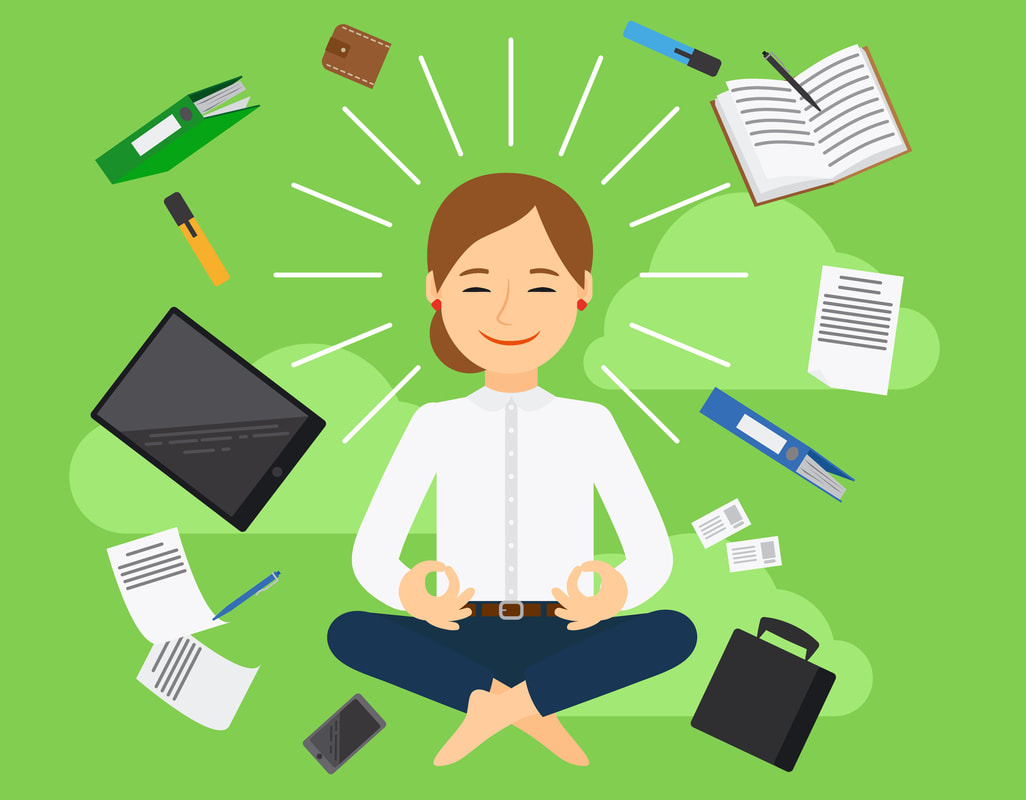
Woman sitting cross-legged practising mindfulness meditation with stressful worries floating around her
Woman practising mindfulness meditation for self-care. Copyright: StockSmartStart

At the start of a new year many of us are making resolutions to improve our physical health by exercising more or changing our diets. But how much thought are we giving to our mental health? By spending a little bit of time each day on self-care, you could help to improve and maintain your mental wellbeing.
 
Why is self-care so important?
 
All of us experience multiple pressures and demands on us every day, whether it’s from work, family life or relationships. And that’s without added stressors such as bereavement or loss, financial difficulties, health concerns or experiencing trauma. And in the midst of dealing with all of this we all too often put our own needs to the bottom of the pile.
 
The result of this can be that we start to feel exhausted and stressed out. Anxiety can creep in or existing symptoms of anxiety can increase. Depression can also worsen and our self-esteem and self-confidence can reduce.
 
How does self-care help?
 
Self-care can prevent or improve feelings of stress, anxiety or depression by giving you the time and space to do something that nurtures your mental, emotional or physical wellbeing.
 
This doesn’t mean getting all zen and meditating every day (although if that’s what you enjoy, go for it!). It means listening to your body and mind, and doing things to give yourself a break.
 
And if it seems daunting to fit yet another thing into the hectic demands of day-to-day life, be reassured that you don’t need to start finding large amounts of time to dedicate to it – although the more self-care you can do, the better. Even taking just a couple of minutes, a few times a day can make a big difference.
 
How can you practise self-care?
 
You can practise self-care in all sorts of ways simply by doing anything that’s about taking time for you. Here are some tips to get you started:
 
1) Move around and go outside
 
Go for a walk and get some fresh air
Do exercise, even if it’s just some simple stretches
Spend time in the garden
Have a picnic in the park
 
2) Pamper yourself
 
Have a bath or shower
Listen to your favourite record
Read a book
Watch a film
Cook your favourite dish
Buy yourself flowers
Wear comfy clothing
Put fresh sheets on your bed
Have a nap or get an early night
 
3) Be creative
 
Write in a journal
Paint, draw or colour in
Play a musical instrument
Bake
 
4) Take time out from stressors
 
Take regular breaks from your computer
Have time out from social media
Switch your phone off at a regular time each night
Chat with a friend
 
5) Relax and remind yourself you’re doing great
 
Close your eyes and imagine being in your favourite place
Practice mindfulness (try the Headspace or Calm apps)
Spend a couple of minutes focusing on your breathing
Stroke a pet
Praise yourself for something you’ve done that day
Write down things you’re grateful for
 
This is by no means an exhaustive list. Each of us has to find the things that relax us and that we enjoy (for instance buying flowers might be lovely for some but terrible if you’re a hay fever sufferer). But whatever it is you do, by taking the time for self-care you can improve your mental health.
0 Comments

    Categories

    All
    Anger
    Anxiety
    Bereavement
    Body Image
    Bullying
    Compulsive Hoarding
    Counselling
    Depression
    Grief
    Happiness
    Loss
    Mental Health
    Mindfulness
    OCD
    Panic
    Relationships
    Self-Care
    Self-Confidence
    Self-Esteem
    Sleep
    Stress
    Suicide
    Therapy
    Work

    RSS Feed

Digital policy
 Privacy policy
Resources

PHONE

07764 702541

EMAIL

[email protected]

location

Odyssey Clinic
63 Kelvin Road
Leamington Spa
Warwickshire
CV32 7TG
  • Home
  • About Me
  • How I Work
  • What To Expect
  • Fees And Payment
  • Contact
    • Location and Opening Hours
  • Supervision